
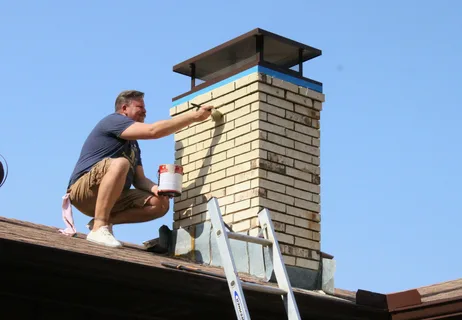
Your chimney is the hardest-working, most exposed piece of masonry on your house. It sticks up above the roofline with no eaves, no gutters, and no shelter. Every rainstorm soaks it, every cold snap freezes it, and every thaw lets the water go to work on the mortar.
In Kitchener, Waterloo, Cambridge and Brantford, that happens dozens of times a winter. Waterloo Region regularly swings above and below freezing through late fall, winter and early spring. Each swing is another freeze-thaw cycle, and each cycle pries a little more at the joints.
Most chimney problems start small: a crumbling joint, a hairline crack in the crown, a gap in the flashing. Caught early, they are straightforward to fix. Ignored for a few seasons, they turn into leaning stacks, leaking ceilings and full rebuilds.
This guide walks you through how chimneys fail, the warning signs you can spot from the ground, the repairs that actually fix the problem, and how to tell whether you need a repair or a rebuild. It also covers what chimney repair costs in Ontario and why the materials your mason uses matter more than most homeowners realize.
How a Masonry Chimney Breaks Down
Almost every chimney problem comes back to one thing: water. Brick and mortar are porous. They absorb rain and melting snow, and when that moisture freezes it expands. Over time, that expansion cracks mortar joints, pops the faces off bricks and opens gaps that let even more water in.
Water gets in through a few predictable routes:
- A cracked or failing crown. The crown is the concrete slab capping the top of the chimney. Once it cracks, water runs straight down into the brickwork.
- Worn or missing flashing. Flashing seals the joint where the chimney meets the roof. When it lifts or rusts, water tracks into the roof deck and your ceilings.
- Old, eroded mortar. Mortar is designed to wear out before the brick does. Once joints recess and crumble, they stop shedding water.
- No chimney cap. An open flue lets rain, snow, animals and debris drop straight inside.
Water is not the only enemy. Acidic flue gases attack mortar from the inside, especially on chimneys venting older furnaces or wood stoves. Settling and shifting can also pull a chimney out of line, and once it starts leaning, the problem compounds every winter.
The key point: damage to a chimney is a process, not an event. The sooner you interrupt it, the less it costs to fix.
8 Warning Signs Your Chimney Needs Repair
You do not need to climb onto the roof to spot most chimney problems. Grab a pair of binoculars, walk around the house and look for these signs:
- Crumbling or missing mortar. Joints that look recessed, sandy or hollow are no longer keeping water out.
- Cracked, flaking or broken bricks. When brick faces pop off (called spalling), water has been freezing inside them.
- White, chalky staining. That powdery residue is efflorescence: salts left behind as water migrates through the masonry. It means moisture is moving where it should not be.
- Brick or mortar debris on the roof or lawn. Small chunks in the eavestrough or around the foundation are pieces of your chimney.
- A chimney that leans or looks out of line. Sight it against a corner of the house. Any lean is serious and needs attention before winter.
- Water stains on nearby ceilings or walls. Brown rings near the chimney usually point to failed flashing or a cracked crown.
- Rust on the damper or firebox. Rust inside means water is coming down the flue.
- A cracked or crumbling crown. If you can see cracks across the top slab, water is already getting in.
One sign on its own may be minor. Two or three together usually mean the problem has been building for a while. Either way, it is worth getting a proper inspection before the next freeze-thaw season makes it worse.
Common Chimney Repairs Explained
A good chimney repair fixes the cause of the damage, not just the symptom. Here are the repairs we carry out most often, and what each one solves.
Chimney repointing
Repointing means grinding out deteriorated mortar to a sound depth and packing the joints with fresh mortar matched to the original brick. It restores the chimney’s weather seal and stops water getting in through the joints. If your mortar is crumbling but the bricks themselves are solid, repointing is usually the fix. Learn more on our tuckpointing and repointing page.
Brick replacement
Cracked or spalled bricks are cut out and replaced with matching units. Matching matters: the replacement brick should be close in size, colour and hardness to the original, so the repair blends in and behaves the same way through winter.
Crown repair and replacement
Small cracks in a crown can be repaired. A crown that is broken, crumbling or poorly built, such as a thin mortar wash instead of a proper slab, should be replaced with a new concrete crown that overhangs the brick and sheds water away from the stack.
Flashing repair
We check and reseal the point where the chimney meets the roof. Flashing problems are one of the most common causes of ceiling leaks near a chimney, and they are often mistaken for roof problems.
Chimney caps
A cap keeps rain, snow, animals and debris out of the flue. It is one of the least expensive ways to protect a chimney, and it pays for itself by keeping water out of the inside of the stack.
Repair, Partial Rebuild or Full Rebuild?
This is the question most homeowners really want answered. The honest answer depends on how far the damage has gone, and it can only be confirmed with a close inspection. As a general guide:
| Condition of your chimney | Usual fix |
|---|---|
| Mortar joints worn, bricks solid, stack straight | Repointing, plus crown or flashing repair if needed |
| A handful of spalled or cracked bricks | Brick replacement and repointing around them |
| Top few courses loose or badly spalled, rest sound | Partial rebuild from the damaged section up, with a new crown |
| Widespread spalling, leaning or unstable stack | Full rebuild down to solid masonry |
A partial rebuild is common on older Waterloo Region homes. The top of the chimney takes the worst of the weather, so the upper courses often fail while everything below the roofline is still sound. Taking the stack down to solid brick and rebuilding from there is often far more economical than repointing a section that is already falling apart.
A full rebuild is the right call when the chimney leans, the bricks are breaking down throughout, or previous patch jobs have failed repeatedly. When we rebuild a chimney, we take it down to solid masonry and rebuild it with a new crown and new flashing included, so you are starting fresh rather than inheriting old problems.
Be wary of anyone who recommends a rebuild without showing you why, or who promises a cheap patch will solve a leaning chimney. A good mason should explain the reasoning behind the recommendation, ideally with photos.
Why the Right Mortar Matters on Older Chimneys
Many chimneys in Kitchener, Waterloo, Cambridge and Brantford were built decades ago, some more than a century ago, with soft, lime-based mortar. That mortar was designed to be the weak link. It flexes, breathes and lets moisture escape, and when something has to give, the joint fails instead of the brick.
The problem starts when an older chimney is patched with modern, high-strength Portland cement mortar. Cement is harder and far less permeable than the original. Water that used to escape through the joints gets trapped in the brick instead. Then winter arrives, the trapped water freezes, and the brick faces start to flake off. The patch looks great for a season or two, then the damage shows up in the brick itself, which is much more expensive to fix.
We covered this in detail in our earlier post, Your Century-Old Brick Wall Is a Legacy System. Stop Patching It With Cement. The same rule applies even more to chimneys, because they take more weather than any wall.
That is why we use mortar matched to your chimney’s original brick in both strength and colour. Before you hire anyone, ask them three questions:
- What mortar will you use, and why is it right for my chimney’s age and brick?
- How will you remove the old mortar without damaging the brick edges?
- Can I see a test patch or photos of similar work?
A mason who answers those clearly is a mason who understands old masonry.
How Much Does Chimney Repair Cost in Ontario?
Every chimney is different, so the only number that really matters is the written quote for yours. Still, it helps to know the ballpark. These are typical 2026 ranges published for the Greater Toronto Area, the closest large market to Waterloo Region:
| Repair | Typical 2026 range (CAD) |
|---|---|
| Chimney cap (stainless, per flue) | $250 to $600 installed |
| Flashing repair | $400 to $1,200 |
| New concrete crown | $600 to $1,500 |
| Partial rebuild of top 2 to 3 ft, with new crown and cap | $2,500 to $5,000 |
| Full repointing of a chimney | $4,000 to $12,000 |
Source: RenoHouse, Chimney Repair & Removal Toronto 2026. These are not our prices; Waterloo Region pricing varies.
What drives the price
- Height and access. A tall chimney on a steep, two-storey roof needs more staging than a short stack on a bungalow.
- Extent of damage. A few joints is a small job. Mortar failing over the whole stack is a large one.
- Materials. Matching heritage brick and mortar to an older home takes more care than a standard modern repair.
- Bundled work. Doing the crown, flashing and repointing in one visit is cheaper than three separate call-outs.
The most expensive chimney is the one left alone. A $1,000 crown repair this year can prevent a $5,000 rebuild a few winters from now.
When to Repair and How to Prevent Damage
Masonry work needs the right weather. Mortar has to cure without freezing, so most repointing and rebuild work in Southern Ontario happens from spring through fall. Late spring and early fall are ideal: temperatures are mild and the mortar cures slowly and evenly.
That makes timing important. If you spot damage in October, book an inspection right away. Some urgent work, such as securing a loose or leaning stack, may need to happen before winter. Other repairs can be quoted now and scheduled first thing in spring, before another season of freeze-thaw cycles does its damage.
A few habits keep your chimney healthy between repairs:
- Look at it twice a year. Check with binoculars every spring and fall for the warning signs above.
- Keep a cap on it. A cap is a small investment that keeps water and animals out of the flue.
- Watch your ceilings. Any new stain near the chimney deserves a call, not a coat of paint.
- Clear eavestroughs. Overflowing gutters can soak the base of a chimney and nearby brick.
- Fix small problems early. A cracked crown or a few failed joints are quick fixes. Left alone, they become rebuilds.
Chimney Repair FAQ
Is a leaning chimney dangerous?
It can be. A leaning chimney means the structure has shifted or the masonry has lost strength. It should be inspected as soon as possible, especially before winter, when ice and wind add stress.
Can I just seal my chimney with a waterproof coating?
Not as a fix for damaged masonry. Coatings can trap moisture inside brick if the joints and crown are not sound first. Fix the crown, flashing and mortar, then talk to your mason about whether a breathable sealer makes sense.
What is the difference between repointing and tuckpointing?
Repointing is replacing failed mortar in the joints. Tuckpointing is a finishing technique that can be part of repointing, using contrasting mortar lines to create crisp-looking joints. Both start with removing the old mortar properly.
Do I need a chimney if I don’t use my fireplace?
Possibly. Many chimneys still vent a furnace or water heater. If yours is fully unused, removal can be an option, but it should be assessed first.
How long does a chimney repair take?
Small repairs like a crown or flashing can often be done in a day. Repointing or a partial rebuild usually takes a few days, depending on weather and chimney size.
Do you serve my area?
We work across Kitchener, Waterloo, Cambridge and Brantford.
Don’t Wait for the Next Winter
Every freeze-thaw cycle makes a damaged chimney a little worse. What is a crown repair today can be a partial rebuild in two winters and a full rebuild in five. The good news is that most chimney problems are easy to spot from the ground and straightforward to fix when caught early.
At Waterloos Old Fashioned Masonry, we fix the cause, not just the symptom. Our process is simple:
- Reach out and tell us what you have noticed.
- Inspection: a top-to-bottom look to find the real source of the problem.
- Clear estimate: a written quote that explains the work and the cost.
- Quality repair with mortar and brick matched to your chimney.
- Final check: a walkthrough of the finished job, with your roof and landscaping protected and the site cleaned up.
If your chimney is showing any of the warning signs in this guide, contact us for a free estimate:
- Phone: 519-496-9334
- Email: mikecyperling@gmail.com
- Online: Chimney repair in Kitchener and Waterloo
Honest craftsmanship, proper materials and repairs built to outlast Ontario winters.